Can total organic matter stand in for fulvic acid content?
Total organic matter does not directly measure fulvic acid. Interpret the assay alongside its method, mineral or other source and ash content.
Use one method to compare the current and candidate references
Check fulvic acid and water-soluble potassium in both candidates by the same methods. Test mixing and filtration in the intended formulation and water. Use the approved reference to record analytical and application differences separately.
Can mineral-source and other potassium fulvates share an approved sample?
Verify origin, process, analytical definition and behaviour in actual water before deciding whether one specification is appropriate. Irrigation solution formulation: At the intended pH and hardness, evaluate dissolution, color, filtration and sediment on standing. Source and composition review: Request feedstock origin, extraction process and ash content. Compare active fractions on an as-received basis.
Checking Fulvic acid and Water-soluble potassium oxide
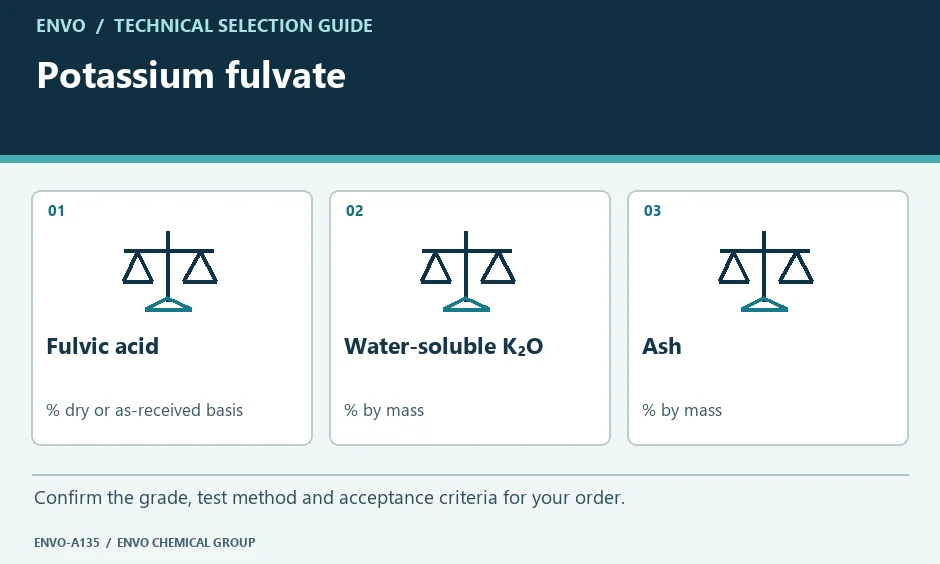
Fulvic acid (% on dry or as-received basis): Specify the measured fulvic acid fraction, extraction method and dry basis. Total organic matter cannot replace this measurement. Water-soluble potassium oxide (% by mass): Express as water-soluble K₂O equivalent. Convert elemental K to the same basis before comparison. Ash (% by mass): Measure ash under the same sampling and ignition conditions. Verify water-insoluble residue separately.
What to record
- Raw material source
- Fulvic acid method
- Ash
- Water-soluble potassium
- Filtration performance
Technical references
Products and processes
Share your application, target properties and test conditions to discuss the next step.
Send a technical or purchasing enquiry ↗