When a specification or provision expresses sorbates as sorbic acid, a potassium sorbate mass needs a stated conversion. Do not copy the salt’s measured concentration into an acid-equivalent field unchanged.
The arithmetic is narrower than the approval
Using rounded molecular masses, sorbic acid is 112.13 and potassium sorbate is 150.22. The theoretical acid-equivalent factor is 112.13 / 150.22 ≈ 0.7464. For example, 100 mg of pure potassium sorbate corresponds to approximately 74.64 mg of sorbic acid equivalents. These figures explain units; they are not recommended food addition levels.
A report starting from sorbic acid equivalents must be divided by this factor to express the corresponding potassium sorbate mass. If the purchased material is not pure potassium sorbate, establish its composition basis first. Keep any conversion to finished-product concentration as a separate step.
| Question | Record |
|---|---|
| What material was weighed? | Offered grade and mass |
| What fraction is potassium sorbate? | Agreed assay and reporting basis |
| What expression is required? | Salt concentration or sorbic-acid equivalents |
Verify the applicable wording independently
The Codex GSFA additive entry and attached category notes illustrate that expression basis and category conditions matter. Have the responsible regulatory specialist check the current provision and destination-market rules. Correct arithmetic does not make an otherwise unsuitable use acceptable.
Retain the original laboratory result next to the calculated field so a reviewer can reverse the calculation. Ask ENVO for the actual offered grade’s identity and composition documents. This conversion does not predict preservation performance, solve crystallisation or establish shelf life; those are different formulation questions with different evidence.
Related decisions
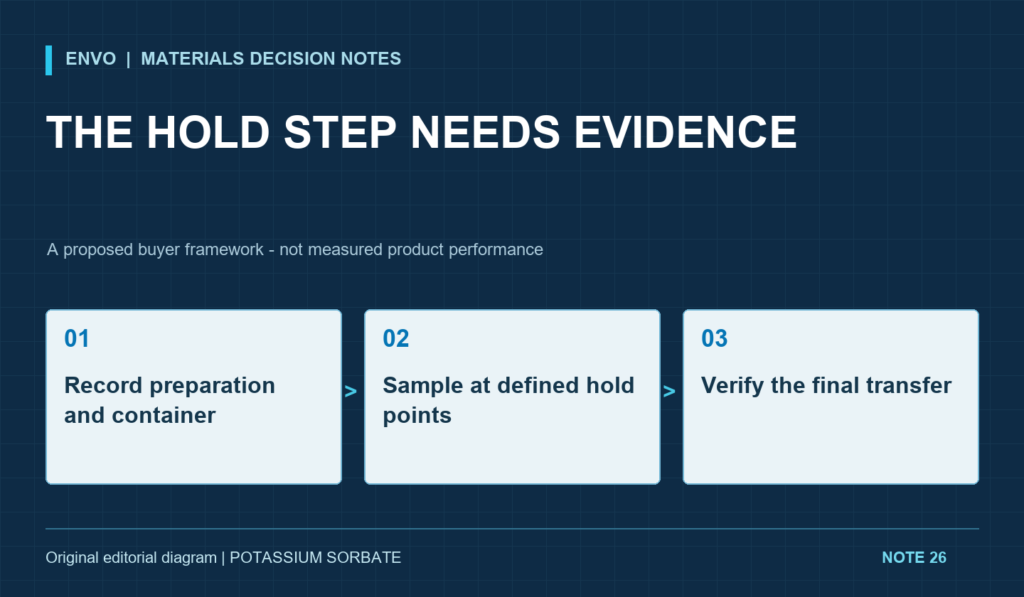
- Potassium sorbate stock solutions: qualify the hold step, not just preparation
- Potassium sorbate after opening: distinguish shelf life, retest date and usable inventory
Review Potassium sorbate product identity and purchasing requirements. For the decision above, send ENVO your application, acceptance criteria, quantity and destination. Confirm the offered grade and available documents before ordering.
Technical references support the stated material or test method. Confirm the offered grade and current acceptance criteria for your application. Quality and document guidance
Share your application, target properties and test conditions to discuss the next step.
Send a technical or purchasing enquiry ↗