
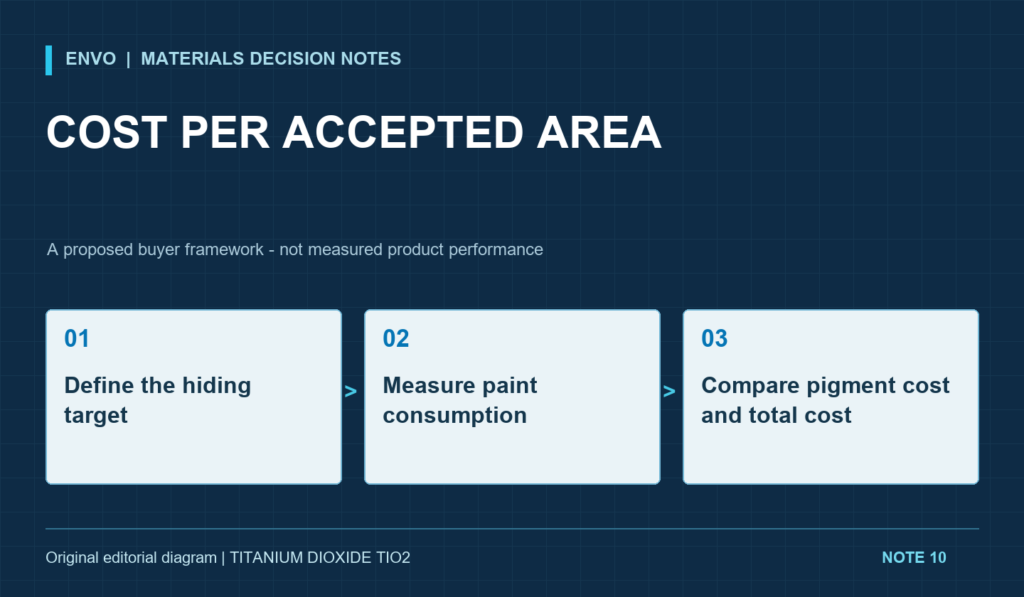
Compare titanium dioxide offers by the cost of meeting the same coating requirement, not only by pigment price per kilogram. An area-based comparison becomes meaningful only after the candidate paint achieves the agreed hiding, film and other acceptance criteria.
Make the endpoint common before comparing money
Chemours’ architectural-coatings overview describes the connection between TiO2, hiding and coverage. It does not establish the coverage of your formulation. Our proposed buying method therefore starts with a measured endpoint: the specified contrast or hiding criterion, substrate, dry-film condition, application procedure and any relevant appearance requirements.
A candidate that meets hiding by producing a different film thickness, finish or durability has not necessarily met the same requirement. Record these conditions alongside coverage. Do not enter a supplier’s claimed spreading-rate advantage as if your plant has already validated it.
A deliberately restricted pigment-cost example
Assume two hypothetical paints have passed the same requirements in the buyer’s evaluation. A needs 0.25 L/m² and B needs 0.22 L/m². Both contain 0.20 kg of purchased pigment per litre of ready-to-use paint. Pigment costs USD 3.00/kg for A and USD 3.30/kg for B. These are invented values for arithmetic, not market prices, formulation advice or ENVO performance results.
| Illustrative calculation | A | B |
|---|---|---|
| Paint consumed at the accepted target | 0.25 L/m² | 0.22 L/m² |
| Purchased pigment concentration | 0.20 kg/L | 0.20 kg/L |
| Pigment consumption | 0.050 kg/m² | 0.044 kg/m² |
| Pigment spend | USD 0.1500/m² | USD 0.1452/m² |
The pigment-only difference is USD 0.0048/m², despite B’s higher price per kilogram. It is not a measured saving, and it is not the difference in total coating cost. Binder, other ingredients, manufacturing, waste and application costs have been deliberately excluded.
Calculate the price premium the evidence can support
Under these assumptions, B’s break-even pigment price is 3.00 × 0.25 / 0.22, approximately USD 3.41/kg. If pigment concentrations differ, include their ratio too. Above that price, this particular coverage benefit alone would not offset the premium. Additional benefits require their own evidence.
For a complete decision, replace the pigment-only numerator with the full cost inside your chosen boundary. Include actual waste and the area that meets all specified criteria. Keep the boundary consistent; comparing one delivered material price with another supplier’s ex-works price can overwhelm a small formulation saving.
Separate diagnosis from commercial evaluation
If the current paint misses hiding, first investigate it using the existing paint hiding-power troubleshooting guide. This article answers a later question: once candidates perform acceptably, what economic difference has actually been demonstrated?
Ask ENVO for the offered pigment grade, current documents and a sample for your defined evaluation. Provide the coating type, acceptance target, current formulation constraints, shipment quantity and destination. A grade’s price premium should be justified by the buyer’s measured result and the confirmed commercial offer, not by generic promises of greater coverage.
Related purchasing decisions
- A passing Hegman result does not prove TiO2 opacity: separate three measurements
- Qualifying TiO2 for exterior paint: ask for the weathering conditions behind the durability claim
For product identity and documents, see Titanium Dioxide (TiO₂). To discuss this decision, send your application and acceptance requirements.
Technical references support the stated material or test method. Confirm the offered grade and current acceptance criteria for your application. Quality and document guidance
Share your application, target properties and test conditions to discuss the next step.
Send a technical or purchasing enquiry ↗
