An exterior-paint pigment should be qualified using evidence relevant to the intended coating and exposure. A rutile designation, a surface-treatment description or an attractive white panel is not a complete service-life claim.
Recognise what the material description does establish
Chemours’ coatings product overview explains that surface treatments influence properties including dispersibility and chalk resistance. This supports asking about the grade’s surface design. It does not establish the durability of a different manufacturer’s grade or of an untested ENVO formulation.
Our proposed qualification record starts with the claimed outcome and works back to the test that supports it. “Durable” needs a stated meaning: retention of gloss or colour, resistance to chalking, film integrity, or another defined property. Those results should not be treated as interchangeable.
Build a claim-to-test record
| Evidence field | Information to retain | Purchasing question |
|---|---|---|
| Coated system | Binder, formulation identity, pigment loading and relevant preparation conditions | Does this represent our intended system? |
| Exposure | Natural or accelerated method, duration and specified environmental conditions | What exposure did the evidence actually cover? |
| Comparison | Incumbent or control coating tested under the same conditions | Is the claimed improvement based on a fair comparison? |
| Outcome | Initial and exposed measurements, acceptance criteria and observations | Which property passed, changed or remains unresolved? |
If a document omits a critical field, record the gap instead of supplying a plausible value. A panel image may be useful supporting evidence, but it cannot replace the missing formulation or exposure record. Ask whether the figures describe a published typical study or the specific candidate supplied for your evaluation.
Keep early appearance and exposed performance separate
A fresh coating can meet its colour and hiding target while leaving the weathering question unanswered. Conversely, a strong weathering result does not automatically resolve application behaviour or initial gloss. Use a staged decision: accept the fresh-film requirements, then review the relevant exposure evidence against predefined criteria.
The NIST report Relationship between Appearance and Protective Durability of Coatings, section 3.3, Chalking, describes chalking in relation to binder deterioration and released pigment. It provides technical context; the historical report is not a current specification for the buyer’s coating and does not validate a service-life number.
Do not turn test duration into years of service without a basis
If a supplier cites an accelerated exposure, ask how it relates to the intended use and what comparison supports that interpretation. Do not convert a number of laboratory hours into guaranteed outdoor years by applying an unexplained multiplier. A useful conclusion may be that a grade merits further evaluation rather than that its field life has already been proven.
Send ENVO the intended exterior system, exposure environment, current grade, required measured properties and qualification method. Request confirmed grade information and relevant available evidence. Actual product performance, warranty terms and supply conditions need an explicit commercial agreement; a generic pigment description cannot supply them.
Related purchasing decisions
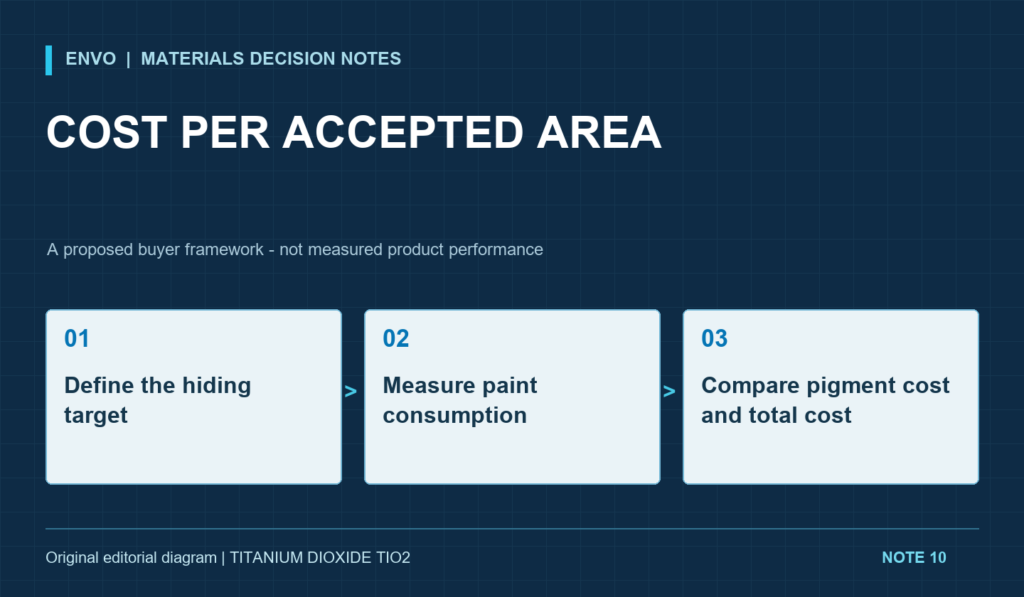
- TiO2 price per kilogram or cost per square metre? Compare a defined hiding target
- A passing Hegman result does not prove TiO2 opacity: separate three measurements
For product identity and documents, see Titanium Dioxide (TiO₂). To discuss this decision, send your application and acceptance requirements.
Technical references support the stated material or test method. Confirm the offered grade and current acceptance criteria for your application. Quality and document guidance
Share your application, target properties and test conditions to discuss the next step.
Send a technical or purchasing enquiry ↗