
Plan a trial for your application
Clear gels
At the same concentration, pH and temperature, compare viscosity, light transmission and bubbles.
Suspension formulations
Use the actual electrolytes and dispersed material to assess separation during storage.
Purchase specifications and incoming inspection
Use these properties to compare grades within the product family. Example figures refer to the cited grade or source. Confirm the offered specification, packaging and lead time in the quotation. Lubrizol Carbopol 980 NF · Polymer specification ↗
| Property | Unit | Published or agreed specification | Test conditions and checks |
|---|---|---|---|
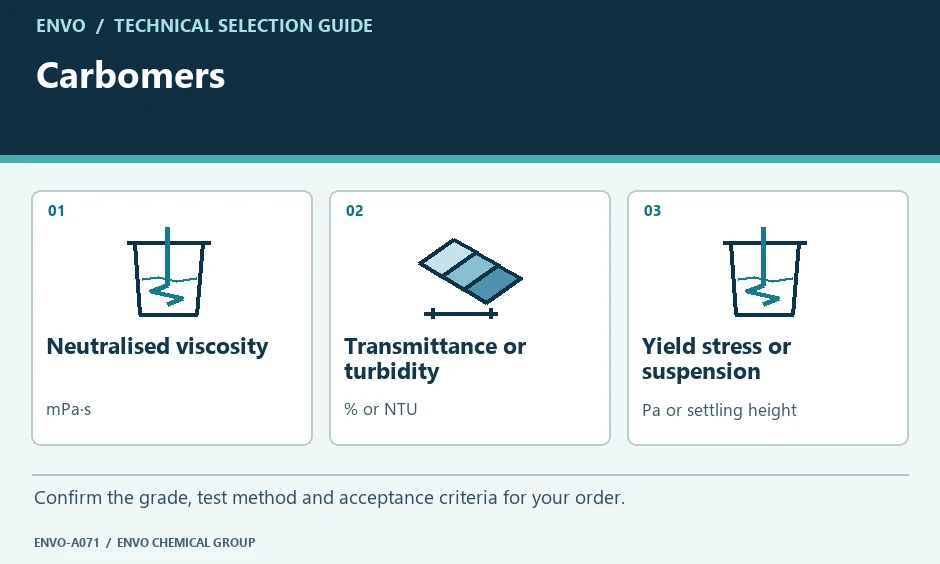
| Viscosity after neutralization | mPa·s | Agree for the grade and end use | Specify grade, concentration, pH, spindle and rotational speed. |
| Light transmission or turbidity | % or NTU | Agree for the grade and end use | Agree the wavelength or turbidity method. |
| Formulation yield stress or suspension | Pa or sediment height | Agree for the grade and end use | List salt concentration and test duration. |
When approving a sample, record the grade, methods, limits and specification revision. On receipt, match the packing lot number to the lot-specific COA and record the measured values and release decision.
From samples to commercial delivery
Packaging and receiving
Seal powder in moisture-resistant bags and distinguish self-wetting and conventional grades.
Storage and handling
Confirm remaining shelf life and storage conditions. Record temperature and humidity before and after sampling.
Sample and order lead times
State processing equipment, trial batch size and monthly demand. Confirm same-grade samples, first-order MOQ, staged deliveries and arrival date.
Questions from the plant
Why are fisheyes visible in the gel?
Check dispersion sequence, feed rate and timing of neutralisation. Confirm complete powder wetting first.
Why does viscosity fall sharply after salt addition despite a passing raw-material result?
Compare grades across the actual electrolyte concentration range and check the neutralisation endpoint.
Report a delivery or batch issue
Include the order number, lot number from the package, label photos and inspection records for the affected lot. When retesting, check Viscosity after neutralization, Light transmission or turbidity, Formulation yield stress or suspension.
Request documents for your application
TDS · Technical data sheet
For grade selection and sample approval, specify the grade and revision required.
SDS · Safety data sheet
Specify the country or region of use and the required language.
COA · Certificate of analysis
Request a sample COA during supplier review. For incoming inspection, provide the actual lot number.