What causes fisheyes in carbomer gel?
Rapid hydration at the surface can leave a dry particle core. Extending mixing time later may not correct the initial wetting problem.
Sample before and after neutralization
Compare addition sequences with the same water and mixer. Inspect particles in samples taken on both sides of neutralization. Then use a salt concentration series to assess electrolyte tolerance.
Why does viscosity fall sharply after salt addition despite a passing raw-material result?
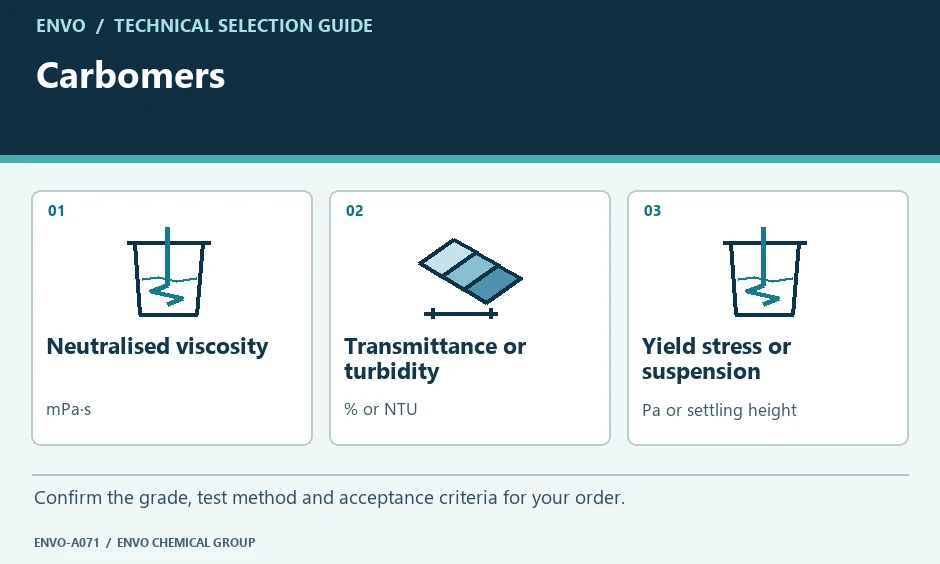
Compare grades across the actual electrolyte concentration range and check the neutralisation endpoint. Clear gels: At the same concentration, pH and temperature, compare viscosity, light transmission and bubbles. Suspension formulations: Use the actual electrolytes and dispersed material to assess separation during storage.
Checking Viscosity after neutralization and Light transmission or turbidity
Viscosity after neutralization (mPa·s): Specify grade, concentration, pH, spindle and rotational speed. Light transmission or turbidity (% or NTU): Agree the wavelength or turbidity method. Formulation yield stress or suspension (Pa or sediment height): List salt concentration and test duration.
What to record
- Addition rate
- Mixing conditions
- Neutralization time
- Gel particles
- Salt concentration
- Viscosity
Technical references
Products and processes
Share your application, target properties and test conditions to discuss the next step.
Send a technical or purchasing enquiry ↗