
Plan a trial for your application
Soft-touch waterborne coatings
Compare touch, adhesion and abrasion on the same substrate at equal coating weight and drying conditions.
Flexibility in waterborne coatings
Add to the existing dispersion at the same dry polymer ratio. Check compatibility, bending and blocking.
| Form or grade | Suitability and verification |
|---|---|
| Anionic, cationic or nonionic | Check compatibility with aqueous additives and the other dispersion first. |
| One-component or crosslinking system | Check whether a hardener is required, then confirm pot life and cure conditions. |
Purchase specifications and incoming inspection
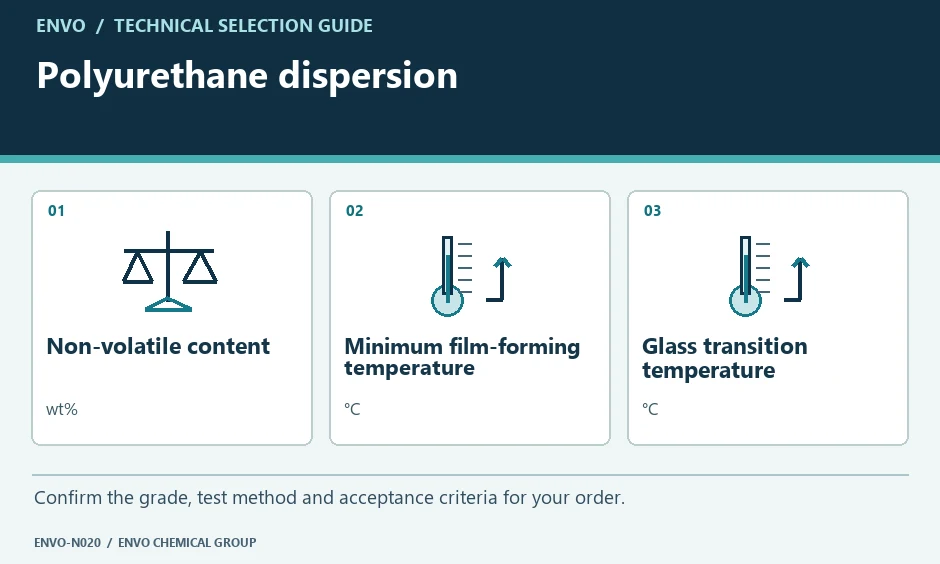
Include the intended grade or current specification in the enquiry. Use the table to compare selection criteria and inspection conditions. The specification agreed by both parties defines the contractual limits. Covestro · Bayhydrol UH waterborne dispersions ↗
| Property | Unit | Published or agreed specification | Test conditions and checks |
|---|---|---|---|
| Nonvolatile content | % by mass | Covestro Bayhydrol UH 240: published approximate value, 40. | Request the drying temperature and time for the proposed grade before calculating the dry formulation. |
| Minimum film-forming temperature | °C | Covestro UH 240 example: approximately 0. | Use the dispersion data as a reference and prepare films under the actual formulation’s temperature and humidity conditions. |
| Glass transition temperature | °C | Covestro UH 240 example: approximately −50. | Confirm method and heating conditions before comparing hard- and soft-segment designs. |
When approving a sample, record the grade, methods, limits and specification revision. On receipt, match the packing lot number to the lot-specific COA and record the measured values and release decision.
From samples to commercial delivery
Packaging and receiving
For liquids, specify drum or returnable container, net mass and discharge connection. Record seals and any separation on receipt.
Storage and handling
Request the grade’s transport temperature range. After cold exposure, recheck particle aggregation and film formation before release.
Sample and order lead times
State processing equipment, trial batch size and monthly demand. Confirm same-grade samples, first-order MOQ, staged deliveries and arrival date.
Questions from the plant
Why does the dispersion flocculate on blending or leave a tacky film?
Compare film formation, adhesion and water resistance on the intended substrate under the actual cure conditions.
Why can a normal-looking dispersion dry to a white film?
Check application temperature, minimum film-forming temperature, thickness and humidity. Prepare panels under both laboratory and intended conditions.
Report a delivery or batch issue
Include the order number, lot number from the package, label photos and inspection records for the affected lot. When retesting, check Solids content, ionic character, minimum film formation conditions.
Request documents for your application
TDS · Technical data sheet
For grade selection and sample approval, specify the grade and revision required.
SDS · Safety data sheet
Specify the country or region of use and the required language.
COA · Certificate of analysis
Request a sample COA during supplier review. For incoming inspection, provide the actual lot number.