Trial design and interpretation
Apply equal wet film thicknesses to the same substrate and vary drying conditions. Record minimum film formation temperature data and the application environment. If whitening follows the process conditions, review drying first and then compare retained samples.
Recording Nonvolatile content
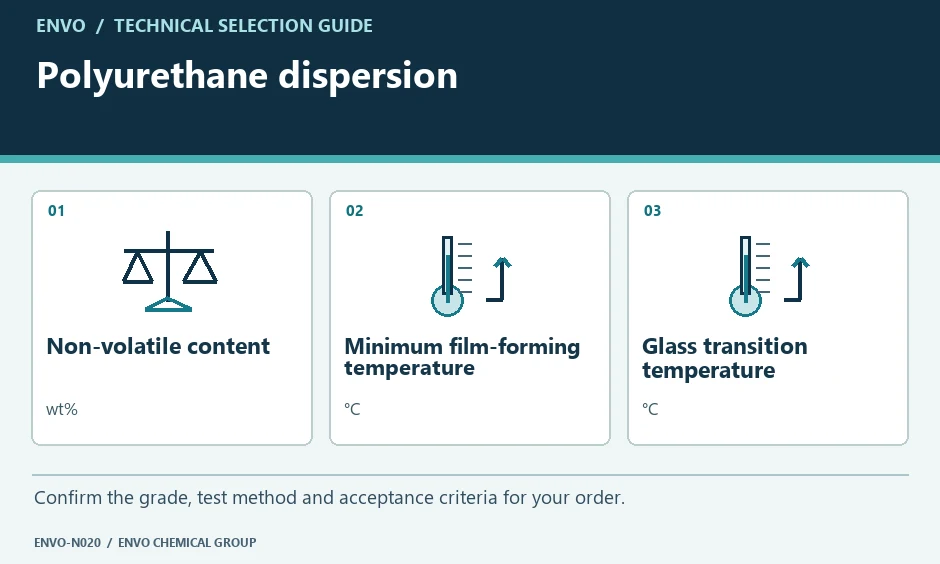
Nonvolatile content (% by mass): Covestro Bayhydrol UH 240: published approximate value, 40. Request the drying temperature and time for the proposed grade before calculating the dry formulation. Minimum film-forming temperature (°C): Covestro UH 240 example: approximately 0. Use the dispersion data as a reference and prepare films under the actual formulation’s temperature and humidity conditions.
Why can a normal-looking dispersion dry to a white film?
Check application temperature, minimum film-forming temperature, thickness and humidity. Prepare panels under both laboratory and intended conditions. Soft-touch waterborne coatings: Compare touch, adhesion and abrasion on the same substrate at equal coating weight and drying conditions.
What to record
- Substrate and wet film thickness
- Ambient temperature
- Drying humidity
- Dry film clarity
Technical references
Products and processes
Share your application, target properties and test conditions to discuss the next step.
Send a technical or purchasing enquiry ↗