
Plan a trial for your application
Wool dyeing
Use the same wool sample to compare levelness, shade depth and staining after washing.
Nylon dyeing
Trial the target fiber and blend ratio. Observe barré and dye compatibility in combination shades.
Purchase specifications and incoming inspection
Use these properties to compare grades within the product family. Example figures refer to the cited grade or source. Confirm the offered specification, packaging and lead time in the quotation. Jacquard Acid Dye · Suitable fibers for acid dyes ↗
| Property | Unit | Published or agreed specification | Test conditions and checks |
|---|---|---|---|
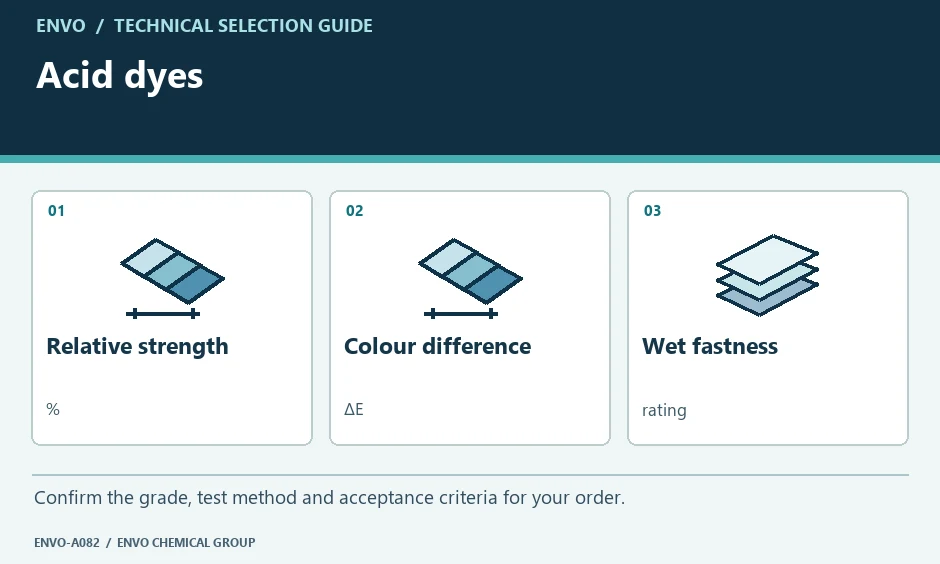
| Relative strength | % | Agree for the grade and end use | Use a common fibre and commercial reference sample. |
| Color difference | ΔE | Agree for the grade and end use | Specify depth of shade, illuminant and reference sample. |
| Wet fastness | Grade | Agree for the grade and end use | Define the test and adjacent material. |
When approving a sample, record the grade, methods, limits and specification revision. On receipt, match the packing lot number to the lot-specific COA and record the measured values and release decision.
From samples to commercial delivery
Packaging and receiving
Pack by shade, strength and lot. Supply a batch dyeing sample and matching label with the shipment.
Storage and handling
Check that residual-metal or restricted-substance declarations meet project requirements. Acid dyes do not all have the same composition.
Sample and order lead times
Specify colour code, surface treatment or filler grade and whether a single lot is required. Confirm trial quantity, MOQ, retention across lots and arrival.
Questions from the plant
Why does a dye pass on wool but produce streaks on nylon?
Check differences in dye sites, pretreatment and the heating and uptake curves.
Why do two lots of the same shade give different depths?
Verify the standard, relative strength, bath pH and target depth before adjusting the recipe.
Report a delivery or batch issue
Include the order number, lot number from the package, label photos and inspection records for the affected lot. When retesting, check Relative strength, Color difference, Wet fastness.
Request documents for your application
TDS · Technical data sheet
For grade selection and sample approval, specify the grade and revision required.
SDS · Safety data sheet
Specify the country or region of use and the required language.
COA · Certificate of analysis
Request a sample COA during supplier review. For incoming inspection, provide the actual lot number.