Why can detergency remain poor at high exchange capacity?
Long-duration exchange capacity does not establish softening achieved in a short wash. The calcium-to-magnesium ratio and detergent system also affect the result.
Use a short cycle and dark fabric to investigate exchange rate
Compare short and long cycles on the same soiled fabric in representative hard water. Measure residual hardness and deposits on dark fabric. Distinguish slow exchange from retained powder.
Why are white spots left on dark fabrics?
Check coarse particles, powder dispersion and rinse count. Include a blank fabric. Laundry powder builders: At actual hardness and wash cycle, compare cleaning and residual calcium. Granular detergents: Check particle uniformity, finished-powder flow and powder residue on fabric.
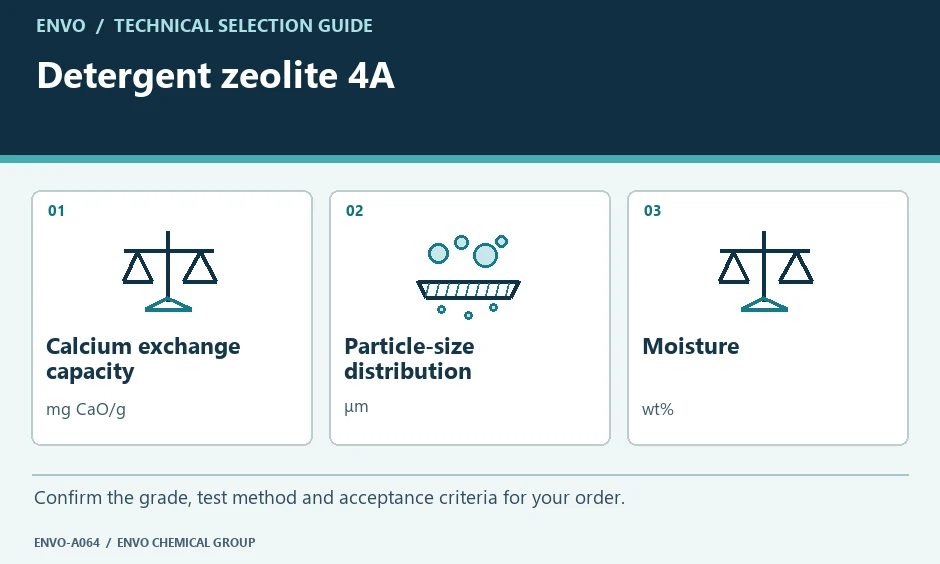
Checking Calcium exchange capacity and Particle size distribution
Calcium exchange capacity (mg CaO/g): State dry basis, temperature and contact time. Particle size distribution (µm): Describe dispersion conditions and the coarse end of the particle distribution. Moisture (% by mass): Test at the temperature and for the duration agreed by both parties.
What to record
- Calcium and magnesium composition
- Wash duration
- Residual hardness
- Soil removal
- Fabric deposits
Technical references
Products and processes
Share your application, target properties and test conditions to discuss the next step.
Send a technical or purchasing enquiry ↗