A Hegman or grind-gauge result can support a defined dispersion check. It does not establish the complete particle-size distribution or prove that a titanium dioxide formulation will meet its hiding target. Keep these three questions separate when reviewing a COA or sample.
Start with the instrument’s stated purpose
The BYK-Gardner catalogue, Fineness of Grind Gages section, describes the gauge as an indicator of coarse particles or agglomerates and explicitly distinguishes it from a particle-size-distribution measurement. That limitation is important when a purchasing specification casually calls a Hegman result “particle size.”
Our proposed evidence map has three levels. A process-control result answers whether the agreed grind criterion was met. A distribution measurement describes a different aspect of the dispersion. A coated-film test establishes whether the formulation meets the optical requirement under its stated conditions. Passing one level does not automatically pass the others.
Match each question with the appropriate evidence
| Question | Evidence to request | Conclusion to avoid |
|---|---|---|
| Does the dispersion meet its coarse-particle criterion? | Agreed gauge method, scale, sample preparation and result | “Every particle has this diameter” |
| How is particle size distributed? | Specified sizing method, sample preparation, distribution basis and reported metrics | “One distribution number proves film hiding” |
| Does the paint hide as required? | Agreed coated-film evaluation, substrate and film conditions | “Any passing grind gives the same coverage” |
Do not compare values recorded on different scales without confirming what each report means. State the method revision and the actual measurement basis. Instrument resolution and laboratory procedure also belong in the interpretation, rather than being replaced by a rounded number on a sales sheet.
Use a passing result to narrow the investigation
Suppose the current and candidate dispersions both pass the agreed grind check, but their finished films differ in hiding. Retain that passing evidence, then investigate the variables it does not resolve. Do not keep treating the Hegman number as a complete explanation of the optical difference, and do not assume that more milling must be the answer.
The responsible development team can compare the actual formulation, distribution data where useful, film thickness and application conditions. Change one important factor at a time or use a documented experimental design. Any additional processing must be evaluated against the site’s approved process window, not extended indefinitely to obtain a preferred result.
Keep incoming release distinct from grade approval
An agreed incoming grind check can be a legitimate release criterion. Grade substitution approval needs the evidence relevant to the customer’s finished product. Define both before evaluating the candidate so a convenient quality-control number does not become a promise of every end-use property.
For an ENVO TiO2 enquiry, include the current gauge method and scale, pigment grade, coating system and the optical issue you are trying to resolve. Request the offered grade’s actual documents and a sample. Confirm whether a reported value is a specification limit, typical value or measured lot result; these documents support different purchasing decisions.
Related purchasing decisions
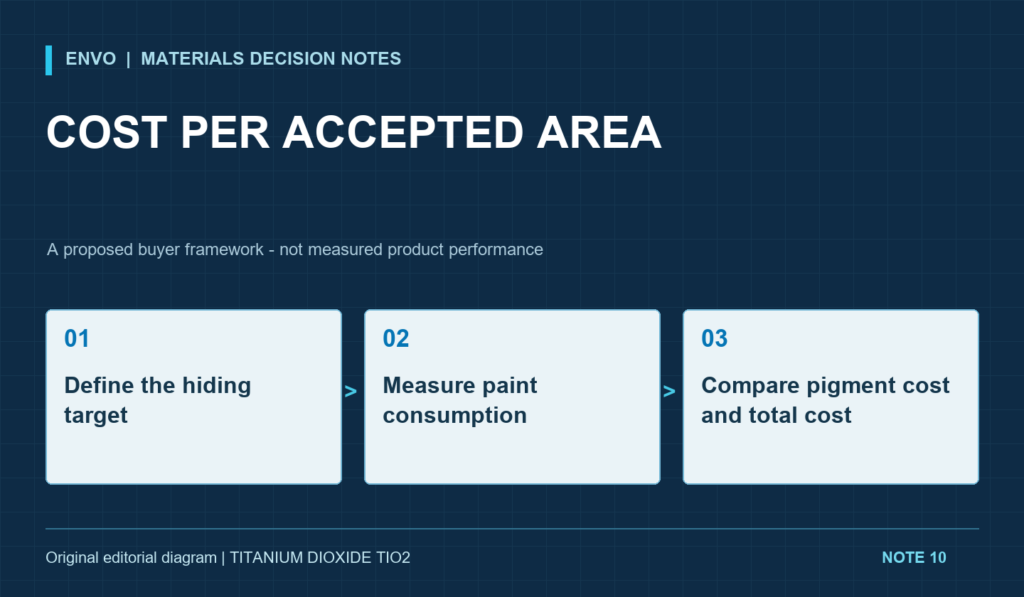
- TiO2 price per kilogram or cost per square metre? Compare a defined hiding target
- Qualifying TiO2 for exterior paint: ask for the weathering conditions behind the durability claim
For product identity and documents, see Titanium Dioxide (TiO₂). To discuss this decision, send your application and acceptance requirements.
Technical references support the stated material or test method. Confirm the offered grade and current acceptance criteria for your application. Quality and document guidance
Share your application, target properties and test conditions to discuss the next step.
Send a technical or purchasing enquiry ↗