Why does a low-viscosity pigment grind thicken at letdown?
The grind and the binder-containing paint are different systems. Minimum grind viscosity cannot reveal all letdown compatibility problems.
Sample before and after adding emulsion
Split one grind. Retain one portion and add emulsion to the other using the actual recipe. Record dispersant dose on a dry basis. Recheck pH, letdown viscosity and storage changes to locate the onset of thickening.
Converting additions to active polymer mass
Suppose two aqueous products contain 40% and 50% solids and all the stated solids are the active polymer being compared. Delivering 1 kg of active material requires 2.5 kg or 2.0 kg of commercial product, respectively. Correct the water introduced before comparing grind and letdown results.
Why do grinds differ at equal product addition?
Convert to dry-basis dose and compare pigment oil absorption, particle size and water quality. Inorganic pigment slurries: At equal solids, test a series of additions. Compare minimum grinding viscosity and fineness. Waterborne paint letdown: After adding the actual latex, measure initial viscosity, hot-storage stability and water separation.
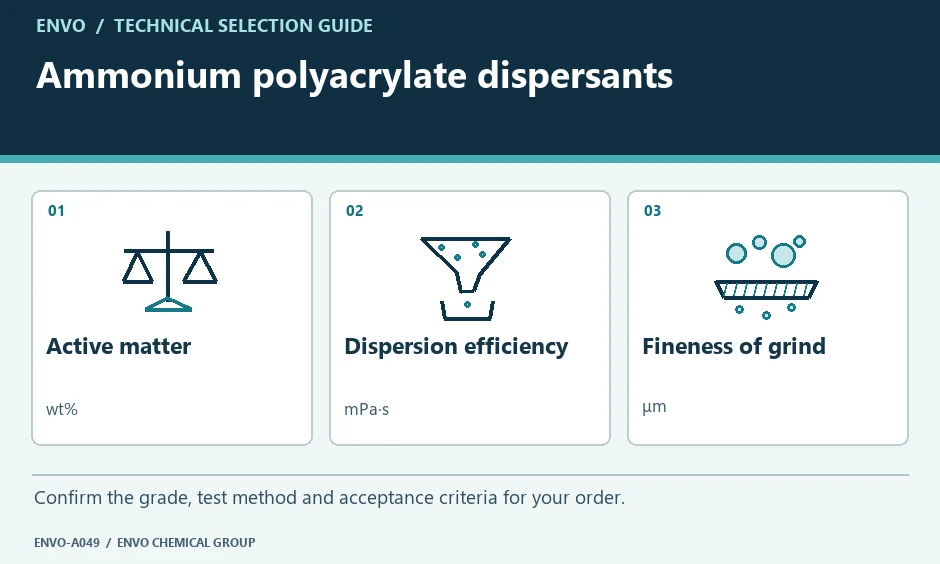
Checking Active matter and Dispersing efficiency
Active matter (% by mass): BASF in-house method. Total solids must not be taken as active content without verification. Dispersing efficiency (mPa·s): Keep pigment loading, temperature and shear constant. Fineness of grind (µm): Specify grinding energy and the fineness-of-grind gauge method.
What to record
- Pigments
- Active dispersant dose
- Grind viscosity
- Letdown pH
- Next-day viscosity
Technical references
Products and processes
Share your application, target properties and test conditions to discuss the next step.
Send a technical or purchasing enquiry ↗