
Plan a trial for your application
Inorganic pigment slurries
At equal solids, test a series of additions. Compare minimum grinding viscosity and fineness.
Waterborne paint letdown
After adding the actual latex, measure initial viscosity, hot-storage stability and water separation.
Purchase specifications and incoming inspection
Use these properties to compare grades within the product family. Example figures refer to the cited grade or source. Confirm the offered specification, packaging and lead time in the quotation. BASF Dispex AA 4040 · Aqueous ammonium salt of an acrylic polymer ↗
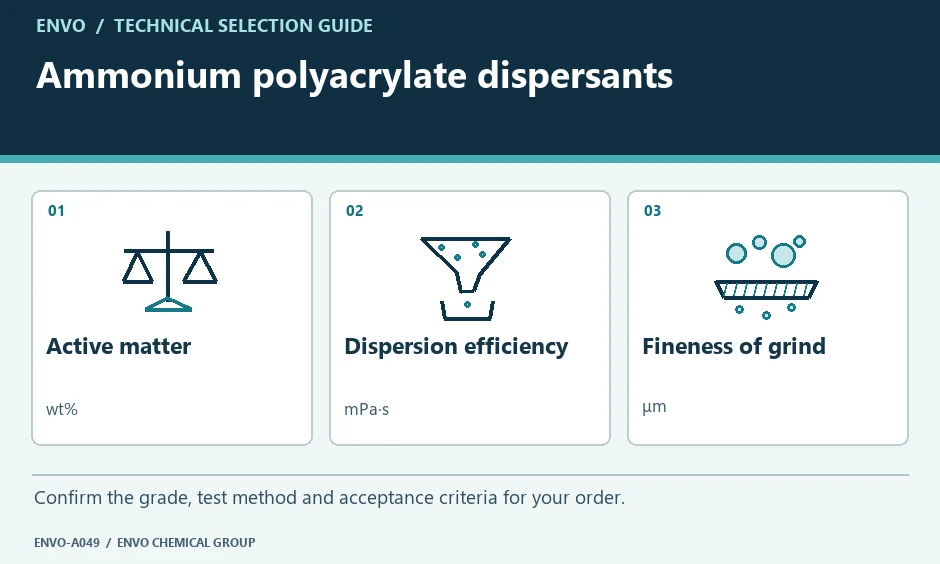
| Property | Unit | Published or agreed specification | Test conditions and checks |
|---|---|---|---|
| Active matter | % by mass | BASF Dispex AA 4040 published example 37.5–40.5 | BASF in-house method. Total solids must not be taken as active content without verification. |
| Dispersing efficiency | mPa·s | Confirm the actual reading once dispersion is stable. | Keep pigment loading, temperature and shear constant. |
| Fineness of grind | µm | Agree for the grade and end use | Specify grinding energy and the fineness-of-grind gauge method. |
When approving a sample, record the grade, methods, limits and specification revision. On receipt, match the packing lot number to the lot-specific COA and record the measured values and release decision.
From samples to commercial delivery
Packaging and receiving
Quote aqueous solutions by drum net weight and active content. Inspect seal and lot.
Storage and handling
Confirm storage and transport temperatures and procedures after freezing. Record pH for retained samples.
Sample and order lead times
Specify colour code, surface treatment or filler grade and whether a single lot is required. Confirm trial quantity, MOQ, retention across lots and arrival.
Questions from the plant
Why does a low-viscosity pigment grind thicken during let-down?
Check latex compatibility, pH and active dispersant dose. Compare the grind before and after let-down.
Why do grinds differ at equal product addition?
Convert to dry-basis dose and compare pigment oil absorption, particle size and water quality.
Report a delivery or batch issue
Include the order number, lot number from the package, label photos and inspection records for the affected lot. When retesting, check Active matter, Dispersing efficiency, Fineness of grind.
Request documents for your application
TDS · Technical data sheet
For grade selection and sample approval, specify the grade and revision required.
SDS · Safety data sheet
Specify the country or region of use and the required language.
COA · Certificate of analysis
Request a sample COA during supplier review. For incoming inspection, provide the actual lot number.