Does higher chlorine content necessarily improve impact resistance?
Chlorine content helps identify the material but does not describe its dispersion in PVC.
Evaluate fusion before comparing notched impact
Use the same PVC and processing settings. Observe fusion, then match notch and temperature for impact testing. Correct differences in sample preparation before judging impact results.
Can CPE replace ACR at equal addition?
Distinguish impact modification from processing assistance, then validate the part and process separately. Rigid PVC profiles: In the same base formulation, compare low-temperature notched impact, fusion and appearance. Impact modification of extruded pipes and fittings: Record extrusion pressure and dimensional stability, and perform the target impact test.
Checking Chlorine content and Volatiles
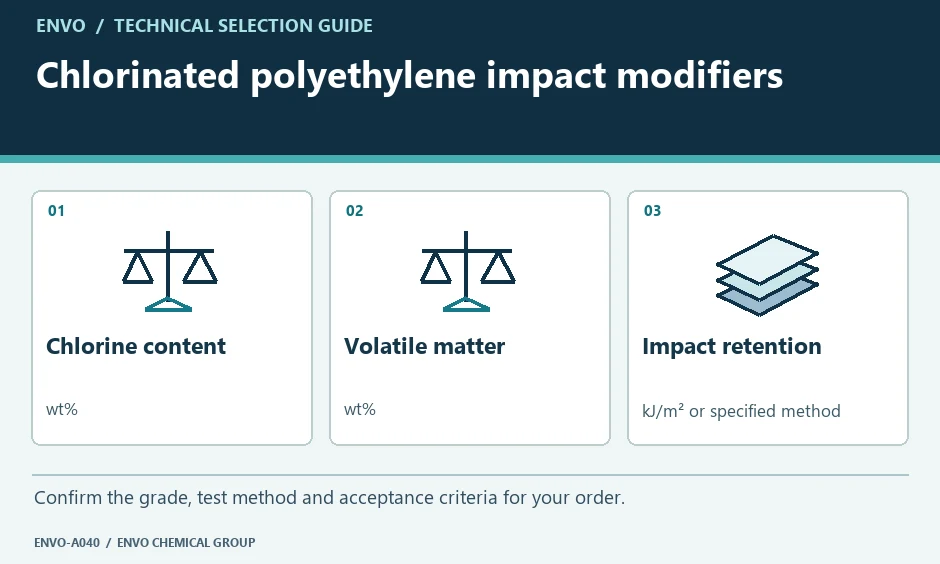
Chlorine content (% by mass): Report on an as-received basis for the corresponding grade. Volatiles (% by mass): Use the same drying temperature and time. Impact strength retention (kJ/m² or method-specific): Keep formulation, specimen thickness, notch and test temperature constant.
What to record
- CPE grade
- Chlorine content
- Fusion history
- Notch conditions
- Impact result
Technical references
Products and processes
Share your application, target properties and test conditions to discuss the next step.
Send a technical or purchasing enquiry ↗