Why can different masses of GAC fill the same bed?
Apparent density affects the purchase quantity. Breakthrough of the target compound affects replacement timing. Measure each separately.
Plot breakthrough against cumulative water throughput
Estimate fill mass using actual bed volume and packing density. Maintain comparable contact conditions in a smaller trial and plot effluent target concentration against treated volume. One initial removal result cannot predict service life.
Estimating initial fill from the filter bed
For example, an effective bed volume of 10 cubic metres and a packing density of 0.5 tonnes per cubic metre give a theoretical initial fill of 5 tonnes. Confirm usable depth and actual packing density under site filling conditions. This calculation does not establish when the carbon must be replaced.
Can iodine number predict the replacement date?
Use breakthrough monitoring with actual influent. Account for competitive adsorption and flow changes. Fixed-bed organic adsorption: Record the breakthrough curve and pressure drop at representative influent quality and flow. Filter carbon replacement: Compare particle grading, attrition and bed expansion within the equipment limits.
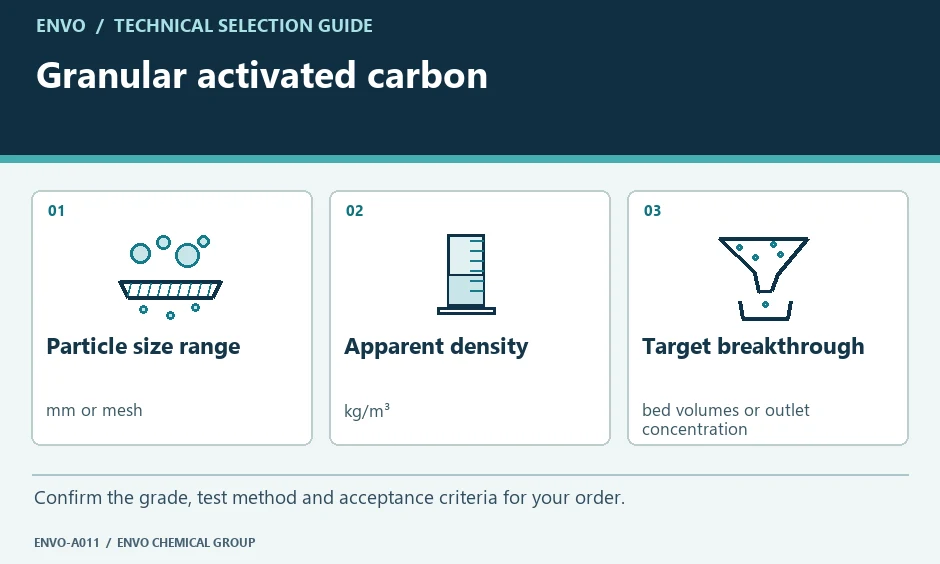
Checking Particle size range and Apparent density
Particle size range (mm or mesh): Agree the mass fractions retained and passing the sieve. Apparent density (kg/m³): Specify the filling method and calculate bed volume and charge mass. Target contaminant breakthrough (Bed volumes or effluent concentration): Define influent concentration, flow rate and endpoint.
What to record
- Bed volume
- Bulk density
- Empty-bed contact time
- Cumulative throughput
- Effluent concentration
Technical references
Products and processes
Share your application, target properties and test conditions to discuss the next step.
Send a technical or purchasing enquiry ↗