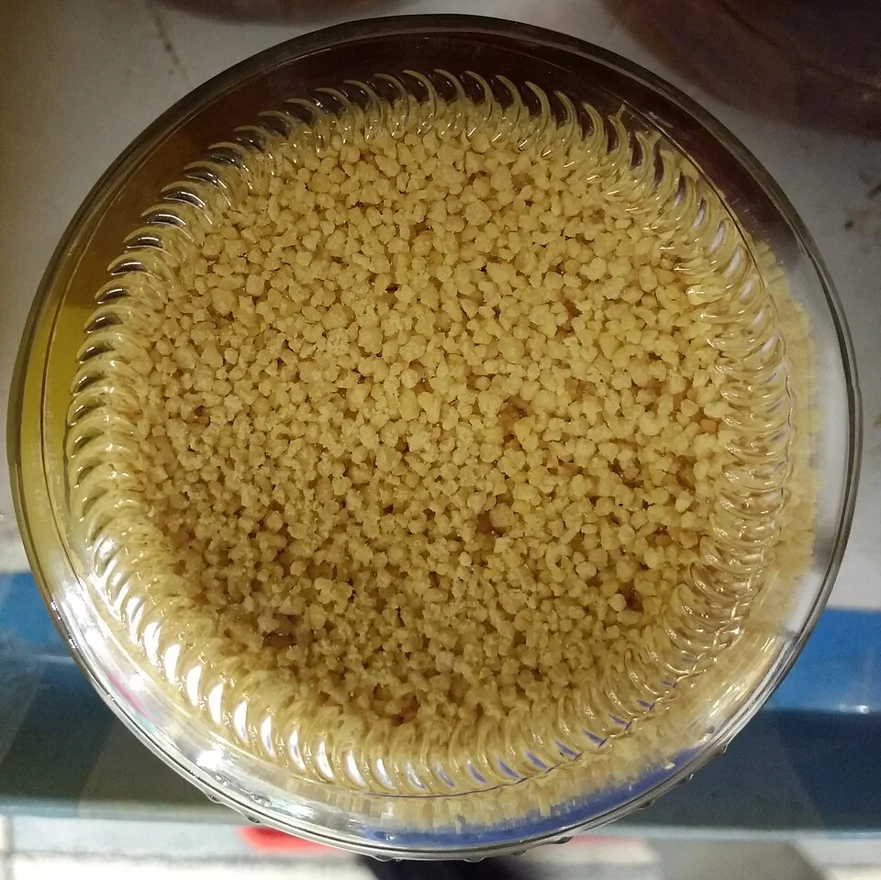
Can deoiled lecithin granules replace liquid lecithin at equal weight?
Changing form changes both the oil entering the formulation and the active components. Using equal commercial weights changes two variables at once.
Replace the oil no longer supplied by the liquid grade
Record botanical source, acetone-insoluble matter and oil phase for each grade. Adjust oil and emulsifier additions independently, compare dispersion and separation under the same process, and review labeling for the new source.
Does a source change require a label review even if the assay passes?
Recheck labelling against actual origin, allergens and rules for the sales market. Oil-in-water emulsification: At the same oil phase and homogenization conditions, compare droplet distribution and separation during storage. Instant powdered mixes: Compare wetting time, floating powder and sediment after reconstitution.
Checking Acetone insolubles and Viscosity or particle size
Acetone insolubles (% by mass): Report for the actual product form. The result does not establish the content of any individual phospholipid. Viscosity or particle size (mPa·s or µm): For liquids, state temperature. For powders, state the sieving method. Source and allergens (Document review): Check the source, such as soya or sunflower, and the manufacturer’s declaration.
What to record
- Source
- Physical form
- Acetone insolubles
- Oil introduced
- Stability
Technical references
Products and processes
Share your application, target properties and test conditions to discuss the next step.
Send a technical or purchasing enquiry ↗