
Plan a trial for your application
Irrigation solution formulation
At the intended pH and hardness, evaluate dissolution, color, filtration and sediment on standing.
Source and composition review
Request feedstock origin, extraction process and ash content. Compare active fractions on an as-received basis.
Purchase specifications and incoming inspection
Use these properties to compare grades within the product family. Example figures refer to the cited grade or source. Confirm the offered specification, packaging and lead time in the quotation. KHUMIC · Potassium humate and fulvate product families ↗
| Property | Unit | Published or agreed specification | Test conditions and checks |
|---|---|---|---|
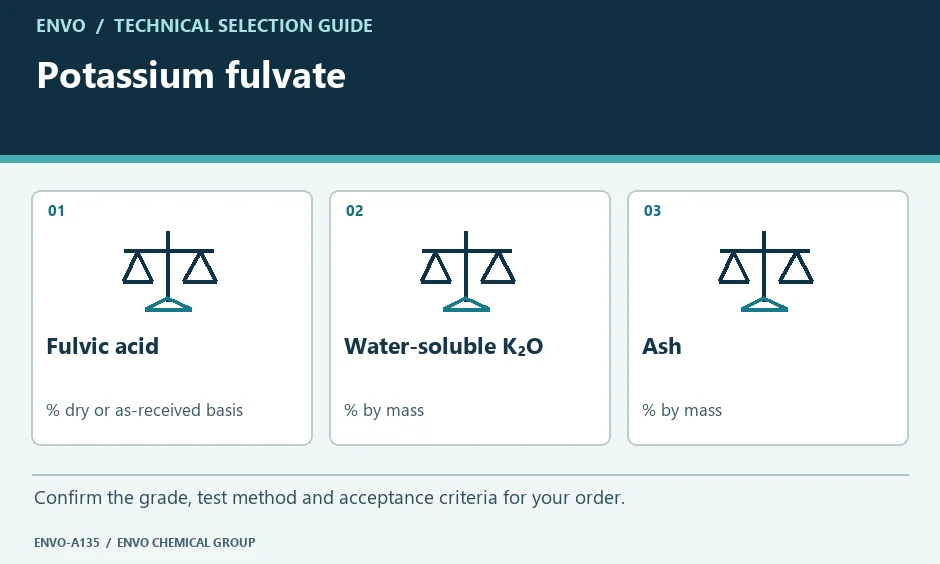
| Fulvic acid | % on dry or as-received basis | Confirm for the proposed grade and project | Specify the measured fulvic acid fraction, extraction method and dry basis. Total organic matter cannot replace this measurement. |
| Water-soluble potassium (as K₂O) | % by mass | Confirm for the proposed grade and project | Express as water-soluble K₂O equivalent. Convert elemental K to the same basis before comparison. |
| Ash | % by mass | Confirm for the proposed grade and project | Measure ash under the same sampling and ignition conditions. Verify water-insoluble residue separately. |
When approving a sample, record the grade, methods, limits and specification revision. On receipt, match the packing lot number to the lot-specific COA and record the measured values and release decision.
From samples to commercial delivery
Packaging and receiving
For solids specify powder or flakes and dry basis. For liquid state solids, net weight and container closure.
Storage and handling
Inspect moisture uptake or liquid separation. Retest a retained sample by the same method rather than judging composition by colour.
Sample and order lead times
State trial use, application season and latest warehouse receipt. Confirm MOQ, dispatch point and expected arrival for samples, initial orders and peak-season replenishment.
Questions from the plant
Can total organic matter replace fulvic acid assay?
Report organic matter, fulvic acid by the specified method and inorganic salts separately.
Can mineral-source and other potassium fulvates share an approved sample?
Verify origin, process, analytical definition and behaviour in actual water before deciding whether one specification is appropriate.
Report a delivery or batch issue
Include the order number, lot number from the package, label photos and inspection records for the affected lot. When retesting, check Fulvic acid, Water-soluble potassium (as K₂O), Ash.
Request documents for your application
TDS · Technical data sheet
For grade selection and sample approval, specify the grade and revision required.
SDS · Safety data sheet
Specify the country or region of use and the required language.
COA · Certificate of analysis
Request a sample COA during supplier review. For incoming inspection, provide the actual lot number.