
Plan a trial for your application
Waterborne exterior coatings
After the specified cure, compare adhesion, water whitening and weathering resistance.
Wood and industrial coatings
On the actual substrate at the intended film-formation temperature, compare hardness, adhesion and blocking resistance.
Purchase specifications and incoming inspection
Use these properties to compare grades within the product family. Example figures refer to the cited grade or source. Confirm the offered specification, packaging and lead time in the quotation. Arkema ENCOR 2140 · Pure acrylic emulsion specification ↗
| Property | Unit | Published or agreed specification | Test conditions and checks |
|---|---|---|---|
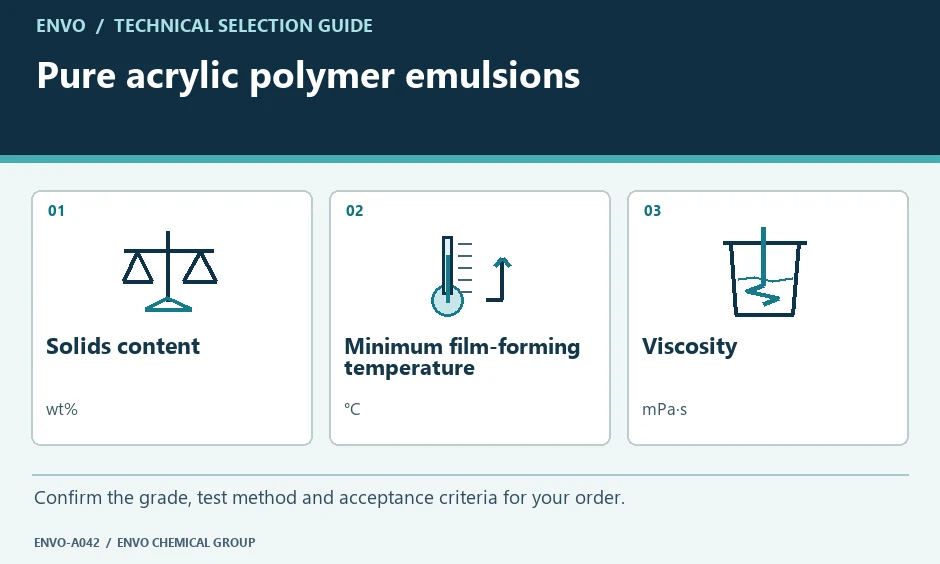
| Solids content | % by mass | Arkema ENCOR 2140 example specification 59–61% | 105 °C, ISO 3251. |
| Minimum film-forming temperature | °C | Arkema ENCOR 2140 typical value 6 °C | ISO 2115. Distinguish typical properties from the contractual upper limit. |
| Viscosity | mPa·s | Arkema ENCOR 2140 example specification 2,000–6,000 mPa·s | 23 °C, Brookfield RVT, 20 rpm. |
When approving a sample, record the grade, methods, limits and specification revision. On receipt, match the packing lot number to the lot-specific COA and record the measured values and release decision.
From samples to commercial delivery
Packaging and receiving
Request drums or IBCs and confirm contamination control, closure and discharge connection.
Storage and handling
Record transit temperature. If freezing or skinning is suspected, retest particles, filter residue and film formation as specified for the grade.
Sample and order lead times
State processing equipment, trial batch size and monthly demand. Confirm same-grade samples, first-order MOQ, staged deliveries and arrival date.
Questions from the plant
Can pure acrylic replace styrene-acrylic at equal solids?
Compare film formation, weathering, gloss and substrate adhesion as well.
Does normal appearance on receipt rule out freeze–thaw damage?
Compare filter residue, viscosity and low-temperature film formation against the retained sample.
Report a delivery or batch issue
Include the order number, lot number from the package, label photos and inspection records for the affected lot. When retesting, check Solids content, Minimum film-forming temperature, Viscosity.
Request documents for your application
TDS · Technical data sheet
For grade selection and sample approval, specify the grade and revision required.
SDS · Safety data sheet
Specify the country or region of use and the required language.
COA · Certificate of analysis
Request a sample COA during supplier review. For incoming inspection, provide the actual lot number.