
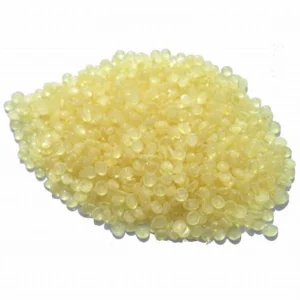
Synthetic Resins
Petroleum resin
Match C5, C9, copolymer or hydrogenated petroleum resin grades to the adhesive base.
View product ↗
ENVO CHEMICAL GROUP / PRODUCTS
Find basic chemicals and functional ingredients by product name, category or use.
Match C5, C9, copolymer or hydrogenated petroleum resin grades to the adhesive base.
View product ↗
For PVC resin, match the viscosity or K-value range and particle behavior to the processing method.
View product ↗
Hydroxyethyl cellulose adjusts viscosity in aqueous formulations. Check dispersion, hydration time and viscosity under defined conditions.
View product ↗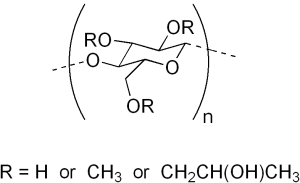
HPMC provides water retention and rheology control in mortars and aqueous systems.
View product ↗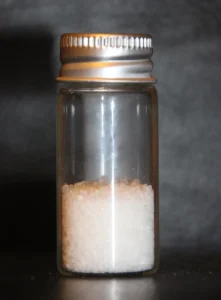
The degree of hydrolysis and polymerization of PVA together affect dissolution and film formation.
View product ↗
VAE redispersible polymer powder redistributes in water and forms a film in dry-mix construction formulations.
View product ↗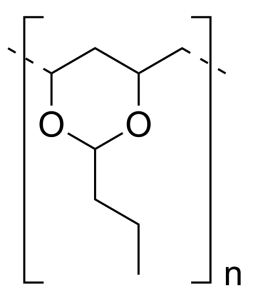
For PVB in inks, coatings and adhesives, distinguish resin powder from finished film.
View product ↗
Choose a polyurethane dispersion by its soft and hard segments, ionic character and curing system.
View product ↗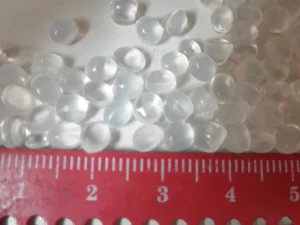
Select polyethylene for the intended process. Blown film, injection molding and blow molding require different grades.
View product ↗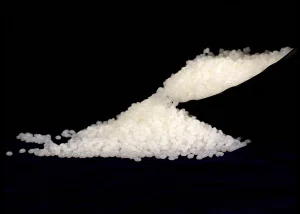
Homopolymer, random copolymer and impact copolymer PP offer different balances of stiffness, clarity and low-temperature impact resistance.
View product ↗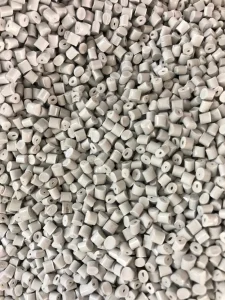
For ABS, compare color, impact resistance, flow and heat resistance on the same grade sheet. Request supporting data for flame-retardant or plating grades.
View product ↗
Separate emulsion and solution SBR, and oil-extended and non-oil-extended grades. Align rubber and oil inputs before comparing compound performance.
View product ↗
Polybutadiene microstructure, molecular weight distribution and processing viscosity affect filler dispersion and wear resistance.
View product ↗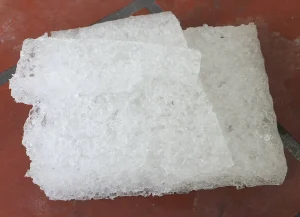
For EPDM profiles, seals and extrusions, check ethylene and diene content, viscosity and whether the grade is oil extended.
View product ↗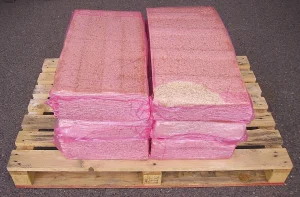
Start NBR selection with acrylonitrile content and viscosity. Verify fluid resistance and cold performance in the actual part.
View product ↗
Specify the commercial natural rubber type, such as technically specified rubber or ribbed smoked sheet. Mooney viscosity and natural impurity limits are separate requirements.
View product ↗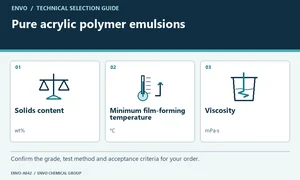
Pure acrylic emulsions are waterborne film-forming binders. Verify minimum film-forming temperature, water resistance and substrate adhesion together.
View product ↗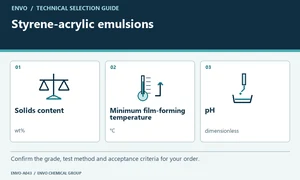
Select styrene-acrylic emulsions for the pigment and filler system, film formation and scrub resistance. Actual coating performance gives more information than solids alone.
View product ↗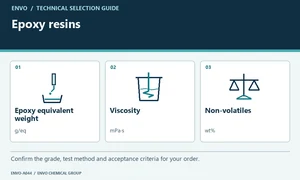
Evaluate epoxy resin with its curing agent. Epoxy equivalent weight, viscosity and form supplied affect mix ratio and application window.
View product ↗
Alkyd resins differ in oil length, fatty acid source and solvent system. Match the grade to application, drying and durability requirements.
View product ↗Contact ENVO
Send a product name, current grade or purchasing list. We can help identify options for your application.